

Spring tends to surface a familiar conversation in facilities programs: whether to increase cleaning frequency, add crews, or accelerate maintenance activity. What gets asked less often is whether the effort is actually coordinated—or just more of the same applied to a different season.
That distinction matters. In distributed facilities programs, increased effort without structure produces uneven results across the portfolio. A coordinated seasonal maintenance program protects asset life, stabilizes labor costs, and establishes the operational predictability that unmanaged transitions erode.
Spring isn’t just a cleaning moment. Managed correctly, it’s an opportunity to protect assets and reestablish consistent performance before warm-weather activity increases.
Why Uncoordinated Spring Transitions Create Lasting Cost
When seasons shift, so does the nature of the maintenance challenge. Winter’s contaminant profile—salt, sand, tracked moisture, road grit—gives way to spring’s: pollen, mud, and the beginning of outdoor maintenance cycles. Facilities that don’t adapt their protocols to match the shift in conditions end up fighting last season’s battle while the new one accumulates.
The consequences rarely surface immediately. They appear in the months that follow—through labor patterns, asset condition, and reactive service requests that trace back to a transition window that wasn’t managed.
Common patterns include:
- Floor finishes worn by winter grit, then subjected to spring moisture before being protected
- Entryway matting and cadence still calibrated for winter conditions as contaminant loads shift
- HVAC filters still loaded with winter particulate, reducing capacity as spring pollen loads increase
- Exterior and interior maintenance running on separate schedules instead of a coordinated sequence
- Floor care costs rising when stripping and refinishing are required prematurely—because the transition window was missed
These aren’t cleaning failures. They’re program coordination failures.
At the portfolio level, the effects multiply. A reactive spring across 200 locations isn’t a temporary inconvenience—it’s a sustained drain on labor budgets and asset life.
What Separates a Maintenance Program from a Cleaning Push
Facilities teams managing the spring transition well aren’t necessarily doing more. They’re doing it in the right sequence, calibrated to actual conditions, and with the verification systems in place to confirm results.
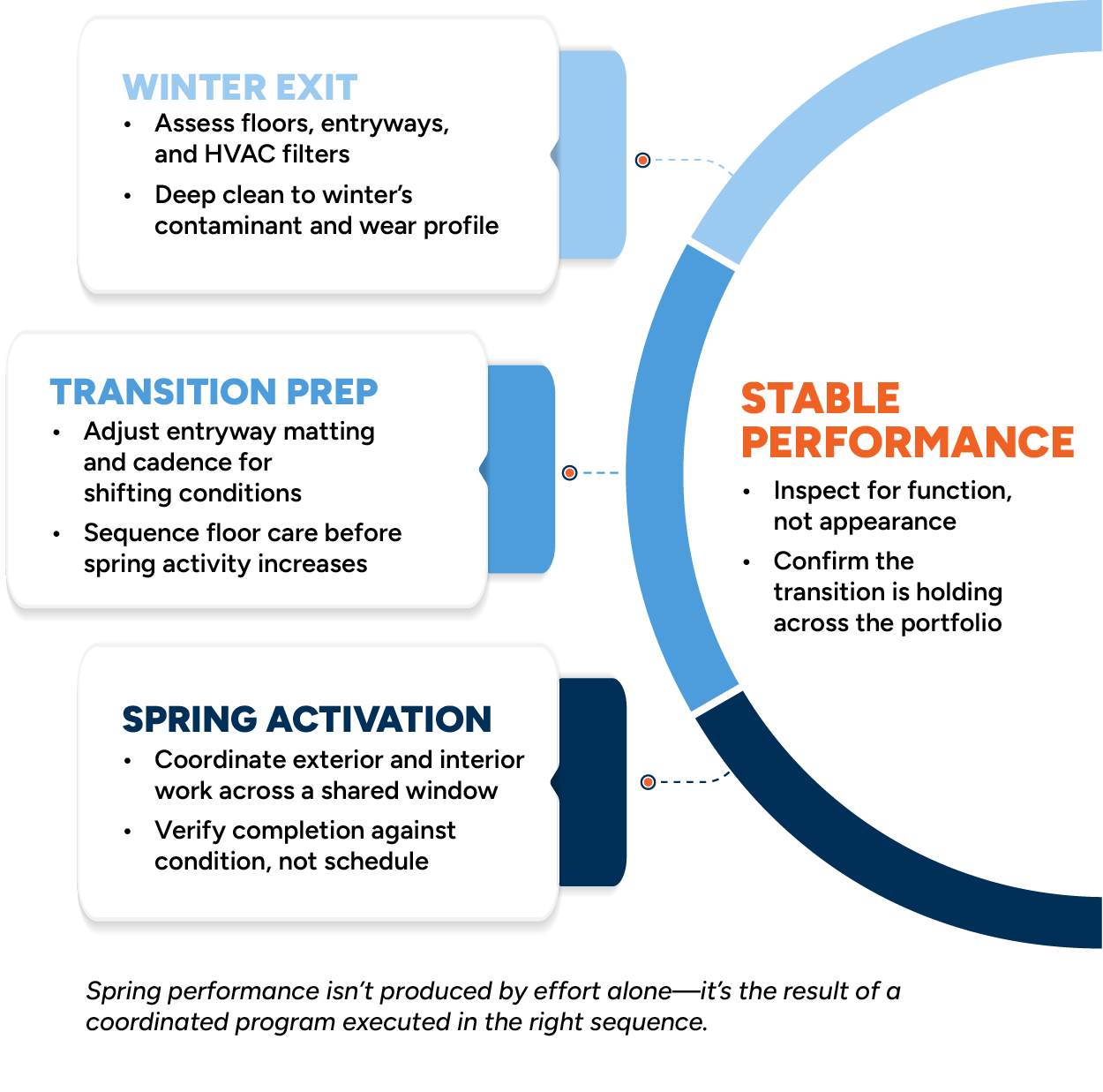
A coordinated spring maintenance program typically includes:
- Deep cleaning scoped to the specific contaminant and wear profile coming out of winter—not just added frequency
- Entryway matting and cleaning cadence adjusted to reflect shifting moisture and traffic conditions
- Floor care—including stripping, refinishing, and protective treatment—sequenced before spring activity increases
- Exterior and interior work coordinated so neither undermines the progress of the other
- HVAC and mechanical preparation completed before pollen season peaks
- Inspections focused on function and condition—not just visual appearance—with documented completion
When these components are aligned across a distributed portfolio, spring stops being a cost spike and starts functioning as a performance investment.
Visibility and Coordination Determine Outcomes at Scale
In single-site operations, informal coordination can work. At 100 or 500 locations, it breaks down.
Spring maintenance programs succeed at scale when they include:
- Standardized protocols that reflect condition changes—not just a seasonal frequency bump
- Verified completion that confirms work was done, not just scheduled
- Coordination between interior and exterior services so execution stays aligned throughout the transition
- Reporting that gives portfolio leaders visibility into where spring transitions are holding—and where they’re not
Without these elements, spring performance becomes an assumption. The locations that are well-managed look fine. The ones that aren’t surface as reactive calls later in the year—by which point the preventive window has already closed.
The Seasonal Transition Reveals How a Program Is Built
Spring doesn’t create new weaknesses in a facilities program. It reveals ones that were already there.
Portfolios that manage the transition consistently—with coordinated sequencing, verified execution, and protocols calibrated to actual conditions—emerge with stable asset performance and predictable labor year-round. Portfolios that treat it as a cleaning event spend the rest of the year managing the consequences.
The seasonal window is one of the clearest indicators of whether a facilities program is structured to prevent problems or equipped only to respond to them.
Evaluate Your Spring Maintenance Program
Identify where seasonal transitions are creating cost exposure—and how a coordinated maintenance program protects floor life and operational consistency across your portfolio.