
Most senior facilities leaders reach mid-year with a version of the same quiet uncertainty.
The program looks right on paper. Service frequencies are set. Protocols are documented. The vendor relationship is stable. And yet — sitting in a QBR, reviewing a summary that was assembled from site reports and completion logs — there’s a familiar, rarely-voiced question underneath the data: is this actually what’s happening?
Not “did something go wrong.” Something more specific than that. The question of whether the performance being reported reflects the performance being delivered — and whether, if those two things have started to diverge, there is any reliable way to know.
For most enterprise facilities programs, the honest answer is: not really.
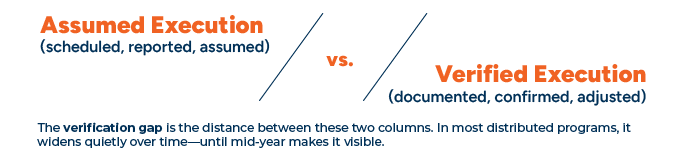
That gap — between what a program is designed to deliver and what can actually be confirmed as delivered at any given moment — has a name. It’s the verification gap. And mid-year is consistently when it becomes most visible.
Why the Verification Gap Exists in Distributed Programs
The verification gap isn’t a failure of intent. It’s a structural condition of operating at scale.
Enterprise facilities programs are designed for a set of conditions: anticipated traffic patterns, seasonal loads, staffing assumptions, and service frequencies calibrated to those expectations. At the start of the year, the design is sound. The challenge is that conditions evolve — and in most distributed programs, the mechanisms for verifying that execution has evolved with them don’t exist at the pace or granularity that multi-site management requires.
The result is a program that runs on documentation rather than confirmation. Completion is reported. Inspections are scheduled. Compliance is assumed. What doesn’t happen, in most programs, is systematic verification that what was scheduled actually occurred — at the right location, to the right standard, under the conditions that actually existed that day.
Over six months, that distinction compounds. Small deviations in frequency, informal protocol adjustments at the site level, staffing changes that affect output without surfacing to the program level — none of these are dramatic events. But in aggregate, across dozens or hundreds of locations, they widen the verification gap steadily and quietly.
The verification gap isn’t dramatic. It’s the accumulated distance between a program designed in January and the operating reality of June.
What Operating Across a Verification Gap Costs
Facilities leaders who have managed large, distributed programs recognize the downstream patterns, even when the upstream cause isn’t clearly named.
- Reactive and touch-up labor increases without an obvious trigger — a reliable indicator that something earlier in the cleaning program isn’t holding.
- Inspection scores remain steady on paper while observable conditions in the field tell a different story — because scores are being generated from self-reported completion rather than verified execution.
- Complaints cluster around specific locations or time periods without a clear operational explanation — because the program doesn’t have the visibility to connect complaints back to their source.
- Mid-year budget conversations become difficult to anchor — because the data available reflects what was planned rather than what was delivered, making it hard to justify adjustments with evidence.
- Vendor conversations default to reassurance rather than documentation — because neither party has a shared source of verified performance data to reference.
None of these outcomes require a poorly performing vendor or a negligent team. They require only the absence of infrastructure that makes execution visible and confirmed across the portfolio. The verification gap is not a people problem. It’s a systems problem.
Why Mid-Year Is the Moment It Surfaces
The verification gap exists year-round. Mid-year is when it tends to become consequential enough to notice.
Early in the year, programs are fresh. Vendor engagement is high. Standards are recently reviewed. Whatever gaps exist haven’t had time to compound into visible symptoms.
By mid-year, conditions have shifted. Seasons have changed. Staffing has turned over. Traffic patterns have evolved. And the program — if it’s running on assumptions rather than verified data — has been quietly adapting to those changes at the site level, without those adaptations surfacing to the program level.
For enterprise facilities leaders, mid-year presents a specific operational window: far enough from the start of the year that drift has had time to accumulate, and far enough from year-end that corrections can be made without crisis-level disruption. It is, in other words, the most actionable moment to close the verification gap — if the data exists to locate it.
The programs that use mid-year productively aren’t the ones conducting the most thorough reviews. They’re the ones with the infrastructure to make the review meaningful — because they have verified execution data to review, rather than assembled reports to interpret.
What Closing the Verification Gap Actually Looks Like
Closing the verification gap requires infrastructure, not effort. It requires systems that make execution observable, documentable, and comparable to the program standard — across every location, in real time, without relying on self-reported completion.
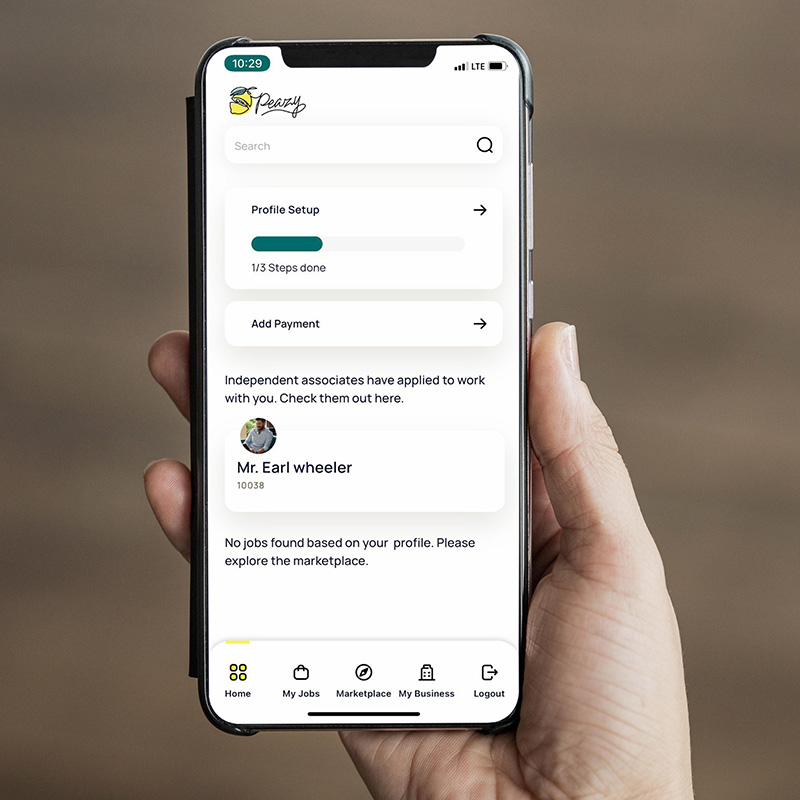
Velociti’s operating model is built on proprietary technology embedded within every account — layered into existing program structures rather than replacing them. In practice, that means four things facilities leaders can verify rather than assume.
Every task is documented at the point of delivery. Site-specific route cards guide frontline teams through prioritized tasks. Completion is confirmed with time-stamped records before tasks are marked done — not reconstructed from reports at month-end.
Photo verification creates an auditable record. Before and after photos are captured for high-priority tasks and uploaded directly to client dashboards. Inspection results, corrective actions, and performance scores are stored with full documentation trails — organized by location and accessible for audit review.
Issues surface immediately, not weeks later. Missed tasks, failed inspections, or flagged conditions are instantly escalated and tracked through resolution. Closed-loop issue management means nothing is marked resolved without a documented outcome — so discrepancies between what was scheduled and what was delivered don’t compound undetected.
Portfolio-level visibility replaces assembled reporting. Custom dashboards give facilities leaders real-time access to performance data across every location — organized by site, task type, or trend. Mid-year isn’t a moment of uncertainty. It’s a moment to review what the data shows.
The verification gap closes when execution is confirmed rather than assumed — and when the data that confirms it is available at the portfolio level, not only at the site.
Assess Your Verification Gap. Find out where the distance between designed performance and confirmed delivery is costing your program — and what closing it looks like across your portfolio. Contact Velociti.
What Verified Execution Produces — In Practice
The value of closing the verification gap is not theoretical. Across Velociti’s national portfolio, verified execution infrastructure has produced documented outcomes in complex, high-expectation environments.
National Banking Portfolio — 470+ Locations
A common pattern in large branch networks is a growing distance between scheduled service and confirmed delivery — attendance that is reported but not verified, inspections that generate scores but not documentation, and compliance that is assumed rather than demonstrated. By implementing digital attendance verification, recurring quality assurance inspections with photo documentation, and executive reporting that reflected actual execution rather than self-reported completion, Velociti achieved 95%+ verified attendance across the portfolio — with measurably improved compliance transparency and reduced service variability across distributed branches.
The improvement wasn’t the result of working harder. It was the result of making execution visible — which allowed the program to be managed rather than assumed.
Corporate Office Tower — Approximately 1 Million Square Feet
Ahead of a significant increase in labor costs, Velociti restructured the cleaning delivery model through team cleaning redesign and schedule optimization — decisions that required understanding the baseline well enough to engineer against it. That understanding came from execution data, not estimates. The result was a 10% labor efficiency improvement and reduced overtime exposure with no degradation in quality standards — because the program could be optimized precisely rather than adjusted broadly.
The verification gap, in this case, was closed before the pressure arrived. That is what made the response possible.
The Question Mid-Year Is Actually Asking
Most facilities leaders already know the verification gap exists. They’ve felt it — in the discomfort of a QBR where the numbers look reasonable but the confidence isn’t quite there. In the reactive labor spike that no one can fully explain. In the complaint that shouldn’t have made it past the entryway.
Mid-year doesn’t create the verification gap. It reveals how wide it has become.
For enterprise facilities programs, the goal isn’t a perfect mid-year review. It’s having the infrastructure to make the review honest — to know, with documented evidence, whether the program that was designed in January is still the program being delivered in June.
When that infrastructure exists, mid-year stops being a moment of quiet uncertainty. It becomes a moment of operational clarity — the kind that supports confident budget decisions, productive vendor conversations, and performance adjustments made from evidence rather than instinct.
That is what Velociti’s operating model is built to make possible — and what the verification gap, once named and closed, stops costing.
Assess Your Verification Gap
Find out where the distance between designed performance and confirmed delivery is costing your program — and what closing it looks like across your portfolio.